In the decade-plus that we’ve brought the benefits of WordPress to large organizations, we have learned their needs are concentrated in four key areas: agility, flexibility, simplicity, and ownership. VIP Go addresses each of those needs in a powerful, intuitive platform with the rock-solid performance and reliability our customers have come to expect from WordPress VIP.
What are the benefits of VIP Go?
Agility
With VIP Go, our customers’ development and marketing teams are more agile than ever. VIP Go introduces GitHub workflows and a new command-line interface (the VIP CLI) which puts more power in developers’ hands to ship new code quickly. Editorial teams enjoy the same intuitive interface as before, with faster turnaround time for shipping new sites and projects.
Flexibility
Direct access to the WordPress API makes it easier than ever for our customers to build exactly the experiences they’re looking to deliver with seamless third-party integrations. With the introduction of true pre-production environments, teams are able to experiment freely, test thoroughly, and tweak to their hearts’ content—all before making any changes to the customer-facing application.
Simplicity
Can we say three cheers for added simplicity anywhere we can get it these days? Our engineers built VIP Go based on over a decade of expertise powering the most sophisticated implementations of WordPress at scale. Over the years, we’ve learned what works, what doesn’t, and how to optimize the experience (from performance to usability to security) so customers never have to worry about things like uptime or traffic spikes. VIP Go bakes that expertise into the very infrastructure of the platform, so customers are free to focus their attention and resources on driving revenue and delivering their product roadmap.
Ownership
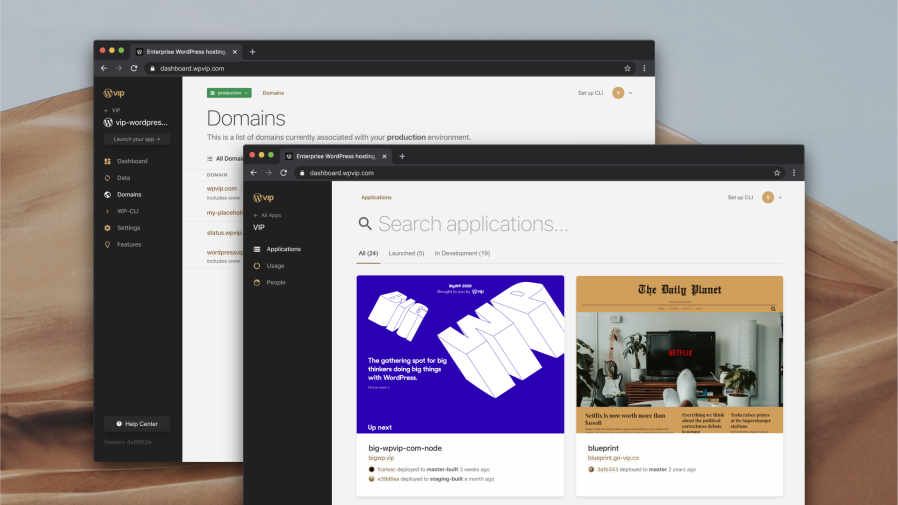
The new VIP Dashboard grants additional visibility and access to content syncs, domain mapping, command line history, and more, putting control of the application in the developers’ hands. The VIP-CLI makes it convenient to run commands and query applications. Furthermore, code review is no longer required, though it is still available for customers on a by-request basis. Our goal is to grant our customers increased ownership of their applications while continuing to provide the world-class support that has always defined our approach to customer partnerships.
What’s next?
As of today, more than 75% of our customers are already enjoying the added benefits of VIP Go. This group includes some of our larger organizations with complex, mission-critical applications—think brands like Intuit, Vanguard, Facebook, and more. Each of these companies migrated from our previous platform to VIP Go with great success, and we’re excited to move nearly all of our customers onto VIP Go by Sept. 30, 2020. At that point, we will begin phasing out support for sites on WordPress.com VIP and transition completely to VIP Go by Nov. 1, 2020. (Are you a current customer with a question about your migration? Please reach out to your Relationship Manager for more details.)
VIP Go is a significant milestone in bringing the best of open source to large organizations who need agility, flexibility, simplicity, and ownership in their software in order to bring out the best in their teams and their business. Content forms the heart of every customer experience, and we believe every customer experience should be delightful. We are proud to play a role in making the web a better place, one deploy at a time.
Fresh from the January relaunch of Five O’Clock on VIP, men’s grooming brand Harry’s is in the process of launching a major initiative and set of partnerships that evolves the brand’s mission in culture and sharpens its editorial focus. Last week Harry’s released a new short film emblematic of the new approach, entitled “A Man Like You”:
We caught up with Caitlin Ganswindt, Editor at Harry’s, to hear about what’s in the works and the journey that brought her, and them, here.
Ganswindt came to Harry’s in late 2015 after serving as managing editor at Shinola and leading experiments with native, branded content at Urbandaddy. Since its origins in 2013, Five O’Clock has gone through a number of stages in its evolution from pioneering native brand magazine to the bigger cultural mission it is now embracing.
Tell us about the history of Five O’Clock and where you have taken it in since you joined.
We’re coming up on our 5th year anniversary at Harry’s in March. So you’re talking about, in 2013 starting a native publication with a very small group of people. Whatever story pitches we got pretty much went up on site. When I joined the team, they were looking for somebody who could figure out what the editorial strategy should be, and migrate the site on to a non-self-hosted solution. We just didn’t have the engineering resources to support a site, that we didn’t really know how to quantify yet, and didn’t really know the value of yet.
The original site was custom and proprietary, and very, very binary. There were only a couple of formats that we had to choose from. All of the assets were required and very finite. There was no tagging. There was no way to search on site. It was a rudimentary sort of blog…hole.
I spent the first couple of months, November and December of 2015, just doing a complete audit of the site. Everything we had run, things that worked, things that didn’t, and tried to hypothesize the what and the why. Then, in January of 2016, I made a proposal to migrate on to a customized WordPress theme, so that we could get away from the engineering constraints, and actually start testing against our point of view in real time. I started development of the second iteration of Five O’Clock using the Zuki theme, with a full custom CSS overlay of the existing theme templates.
On the last day of March 2016, the last day of Q1, which was a feather in my cap, we went live with that iteration of the site. We received a Webby nomination, and it was met with a lot of love from customers and industry folks. People were into it! They were really excited about the content that we were producing.
What was the new editorial focus?
We started talking about grooming education. We started talking about brand happenings. Business initiatives. Iterations of our products. We introduced people to our factories. We started putting faces to the names behind our products.
And then in November of that year, 2016, we launched Five O’Clock News, which is a monthly newsletter of Five O’Clock content.
That’s also been doing really well. We have very consistent readership, with numbers firmly above industry averages. More than half of everybody who receives our emails are opening them, engaging with them, and sharing them on a regular basis.
Do you have a mental picture of what’s been most popular and what the profile of the readership looks like, based on what works and what doesn’t?
We’ve actually gone through another iteration with this new site launch, but the very clear things that are trending, and are still true today: first, grooming education. Actually learning the “how” and “why” behind the tools we make and products and practices. Highlighting ingredients – the differences between shave cream and shave gel and why you should care. How to match the grain patterns on your face to optimize your shave.
Then in January of 2017, we starting thinking as a brand and marketing team more seriously about our point of view as a company. And have been working over the past year to bring that brand mission and positioning to life in the real world.
In tandem, we realized that while the new Five O’Clock site was really beautiful and doing great things, it was also grounded in three categories: better grooming, better mornings, and better life. Because our original positioning of the brand was – “the shaving company that’s fixing shaving” – being really frustrated by the margins in between what it cost to make something, and how much people were actually paying for razors from the bigger guys. While that’s where our story started, and we realized that we can do a lot more with this microphone.
A conversation with Hamilton’s Javier Muñoz, on life, work, and his path to understanding his own masculinity
We started thinking about what we truly believed, and realized that our focus was really more about this idea of progressive masculinity. Harry’s is committed to amplifying the ongoing cultural conversation around what it means to be a man today. Because men can be both strong and nurturing, self-assured and accepting of others. The big overarching picture is that to be a good man is to be a good human. We’ve always felt that existing shave brands weren’t speaking to us in a way that resonated. And again, since launching, we’ve learned so much about our customer values. So we wanted to do our part in opening up that conversation and try to modernize ideas around masculinity, to better reflect who our customer really is.
Obviously we know that shaving is inherently masculine, and the category has been dominated by brands that have perpetuated this traditional idea of masculinity as “being the best, the strongest, the smartest, the toughest.” But in real life, guys are a lot more than those traditional stereotypes. There is no one box that can define a person, and we feel like it’s time for brands to promote a more progressive vision of masculinity. But, moreover, we want to help guys define what it is to be a man on their own terms. Embrace whatever attitude and behaviors actually are resonating with them, and have a safe space to be who they are, or who they’re not, and embrace the parts of themselves that have previously been off limits according to these outdated ideals.
It’s quite a maturation of vision from “fixing shaving” to this bigger, cultural piece, with a lot of area to explore.
Yeah, definitely. We’re rolling out our new social mission over the coming weeks as well. Harry’s is partnering with a few really wonderful charitable organizations, to donate a portion of our profits to, and join the movement behind the initiatives and the conversations that they are pushing forward.
But by and large, as far as Five O’Clock is concerned, we’ve realized there’s a real whitespace when it comes to men’s lifestyle content. With all these fights for gender, marriage, class, equality, all over, men are facing new dynamics that are having them question these traditional ideals of what it means to be a real man. We think that the tension between the past and the future are really important to highlight and have real, candid conversation around.
We feel that Five O’Clock is a microphone to amplify these voices and galvanize this new generation by cultivating a space for real discourse. I think what drives us most is to lead in culture and raise awareness by bringing positive attention to these progressive shifts, rather than just focusing on the negative.
Lena Waithe on the significance of her Emmy win, her career path, and the causes she supports
Tell us about where you are today with that mission and project. What has been shared so far?
We have a new brand campaign that came out on the 26th. It is a video called “A Man Like You.” I think that may bring to a finer point the goals of the messaging.
One of the partners we’re aligning with is The Representation Project. They’re focused on helping guys understand misrepresentation and breaking down barriers of harmful stereotypes. We worked with GSD&M, a creative agency out of Austin and The Representation Project to create this film. We’ve also rolled out on Five O’Clock, profiles with the founders of The Representation Project and A Call to Men, another organization that we’re partnering with for our social mission. In the UK we’re collaborating with an organization called CALM (Campaign against Living Miserably) that focuses on awareness on mental health and also suicide prevention among men. We’ll have a profile and some great initiatives coming out with them soon.
Over the next several weeks and months, you’ll definitely see us putting a bigger stake in the ground around these conversations for sure.
It all sounds amazing. How do Five O’Clock and Harry’s fit together? How does the one connect up with the larger organization?
We feel like Five O’Clock is the place where our point of view can be loudest. It’s the most concentrated as far as participating in these conversations. It serves as a point of discovery and inspiration for people who feel like they’re ethos and values are in line with this progressive future.
It definitely serves as a contrast, particularly if you look in the broader world of beauty across masculinity and femininity – having a strong magnetic pull that says ‘This is what we’re about. If you’re about this, become a part of our…of us.”
Totally, and I think that’s definitely the goal. And it’s not to say anybody else is doing it wrong. Brands have found, and will continue to find success in myriad ways. But taking two steps back and reflecting on the state of culture and the world right now, we feel like particularly that grooming—you can call it beauty, sure—it’s a lot deeper than that. Shaving is important for upkeep, but it’s also a moment to make you feel good. And there are so many other things that are important to feel good as a human.
What do you think about the observation that in the current political moment, skincare is all of the sudden becoming a bigger piece of self care than it was before?
I don’t necessarily know if that is tied to a cultural moment. I think that care routines in general are becoming more center lane, and I think that that’s a little bit more of a technology thing. With social media, if you look at Glossier, Fenty Beauty—it’s the age of bloggers—we’ve never before had such democratized access to product reviews in real time.
If you think back to the original general store, if you needed a product, you went and you talked to the shopkeeper and said, “This is what’s going on and this is what I need.” And they would make a recommendation on the right product for you. You weren’t competing with branded advertorials. It wasn’t the guy who has the most money made the loudest boom, and that’s who you went with.
And now, in the age of bloggers, and independent brands, and direct to consumer, I think that we’re actually coming back to that original moment of …all of this information is available, so it’s about what you need and what you want and then you can find the product and brand that is most in line with that. I think it goes beyond just the quality of the products themselves and ladders up more to, “Is this brand for me in general?”
Tell us about the current iteration of the site, and the move to VIP.
As we were working on this updated brand positioning, we realized we’d also need to overhaul the Five O’Clock editorial mission to be in line with that. So we were thinking, yet again, of overhauling our content space. Part of the challenge we wanted to solve for was to be able to see the whole 360-degree user funnel. We wanted to improve our approach to data as far as who is using the site. Are they Harry’s customers? Are they more valuable because they are reading our content? Those kinds of questions, and that’s how we came to VIP.
In March of last year I put together a proposal for this migration. And then building all of the piping on our end to use the analytics we’re now able to use. We started development in September, and we launched live in January of this year. The whole site is fully custom. We’re doing some really cool things as far as styling on galleries. We have a really lovely dynamic scroll on the homepage as well as all of our article pages that have a gradient treatment, which is not something we see super often. Also, the entire site is set up super scalable to our business needs. For example, we built in hexadecimal code fields for every category on the site. Which means changing the look and feel of the homepage is as simple as changing the color scheme that’s aligned with a particular content category. So, if we had a big campaign or partnership we were rolling out that we wanted to do a whole new treatment for, we have that immediate flexibility without actually getting in to the code.
We’re also now running a reverse proxy for hosting, so the domain is now Harry’s.com/fiveoclock. We’ve also set up a child environment where we can theoretically host all of our acquisition/DR pages. So for the first time everything that we’re creating as a brand is all indexed against the same domain, providing that full 360 user funnel.
Over the next year, two years, and beyond, my focus is going to be figuring out what that attribution model looks like, understanding the real brass tacks – things like profitability of content on long term customer value. And that’s definitely where we’re heading next.
How does this new brand and site relaunch feel for you, to have done so much in evolving Five O’Clock multiple times in such a compressed period of time?
I think that this is a next step in one of the most exciting years for Harry’s as a brand, and Five O’Clock as a publication. I definitely feel lucky that, as an editor, we’ve had such confidence from our co-founders from the start, and that we were given the years necessary to hone in and prove out the channel. And I’m just really excited for the opportunities Five O’Clock has ahead.
You’ve built a very progressive case and grown this thing deliberately over time. Any advice for others who might be trying to develop similar evolutions for their publications?
I think the most important thing is to keep yourself in check. Particularly working at a brand, if you’re talking about native content, there tends to be one editorialist in a room. So that person needs to remember to take two steps back and ask themselves “Do I give a shit about this piece of content that I’m putting out in the world? Do I believe in it? Do I care personally?” If these answers are no, then you’re probably not on the right path. At the end of the day, even if it’s branded content, it’s still content, and as an editor, you’re wasting your mind if you’re putting things out into the world that you don’t feel are spurring or perpetuating culture or conversation.
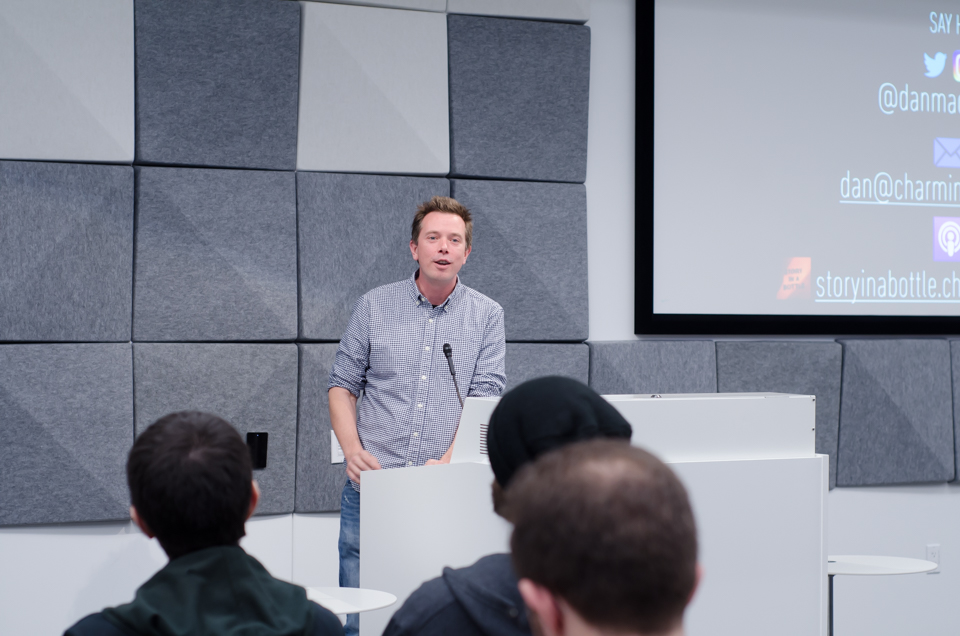
Dan Maccarone of Charming Robot has spent much of his career conducting user research with regular people about how they use various forms of news media. He and his team spend time with them inside of their homes, learning how they get their news and looking over their shoulder to retrace their steps together. Having conducted this type of research repeatedly and over a long period of time, he has developed a keen sense for spotting emerging changes in perception and action. Based on his most recent batch of conversations he identified a few emerging behavior patterns, useful to think about for media companies and brands alike.
Dan shared insights he derived from interviews shortly after the 2017 Presidential Election, at the BigWP meetup in New York in March.
Video is in a new moment
For years video was a feature that users universally scowled at across Dan’s research. The use of video in lieu of text-based articles has finally found strong support among an audience segment. He reports that there’s still a strong negative contingent, but that it is now a polarizing topic – some people seek it out, while others still specifically avoid it. He found about half of the interview subjected preferred video.
Trust has likely never been harder to secure
Viewers are judging everything that passes through their browser with heavier doses of skepticism than ever. This, combined with the feeling that there’s no way to keep up with the ongoing onslaught of new information, makes it a particularly challenging time for publications to foster engagement from their audiences.
Negative news has exhausted viewers
With what feels like a constant barrage of hard news, scandal-chasing, cliffhangers, and fear mongering, viewers feel like they are overwhelmed, and need a break. This seems to be more of an issue with national news, and less so with the local news mix.
Content has to travel to succeed
It’s been the case for many years that most people are visiting sites through side doors rather than home pages. Likewise, Facebook has long since earned a spot next to Google as the starting point for most content journeys. What Dan observes about the current moment is that people are often not noticing where they end up at the end of that journey, and when they do they are holding on to that overarching skepticism. In the video below, Dan shares a conversation he had with an interview subject about what you’d expect to be a benign and non-controversial article.
And to be notified of the next BigWP event in New York, join the Meetup group. There are also enterprise events throughout the year in various other big cities.
If you’d like to hear more about how WordPress.com VIP can free your teams up to focus on publishing, get in touch.
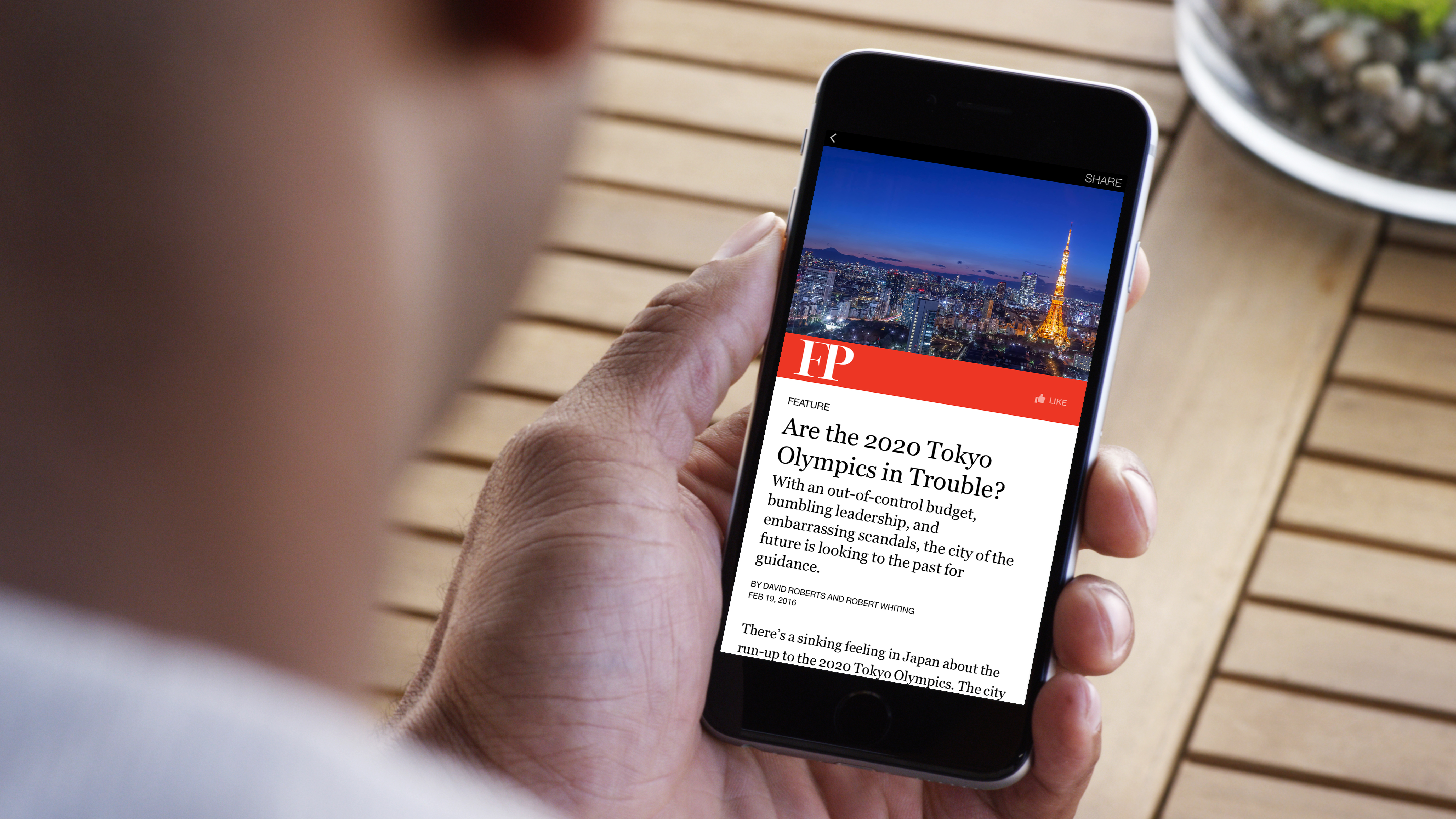
Facebook has announced that its Instant Articles program will be open to publishers “of any size, anywhere in the world” starting on April 12, 2016. And with the free plugin we’re unveiling today, you’ll be able to prepare your self-hosted or VIP WordPress for the demands of this new channel.
Install it now from GitHub (it’s also coming soon to the WordPress plugin directory).
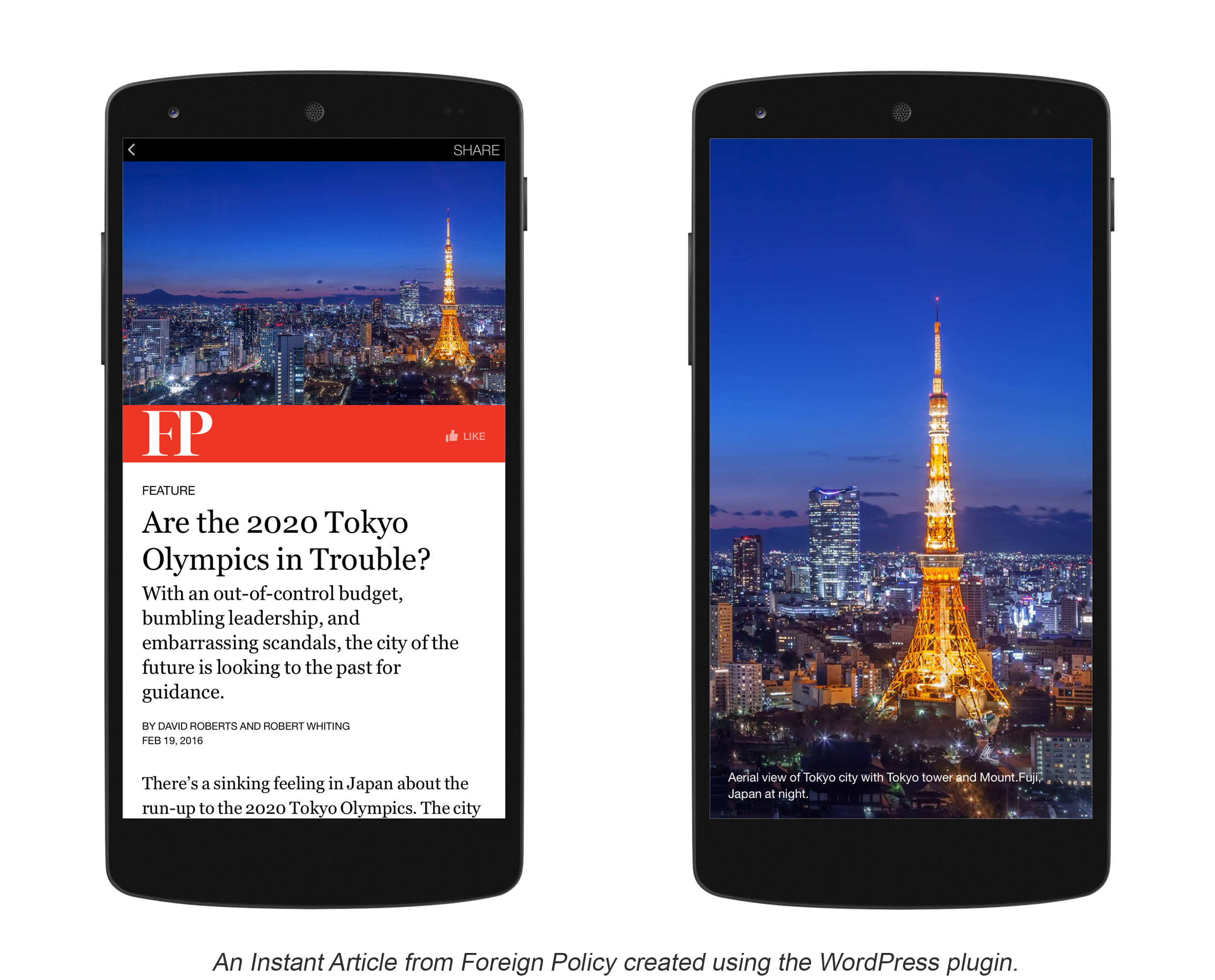
Instant Articles, now available to people using Facebook for iPhone and Android, load articles in Facebook’s News Feed up to ten times faster than standard web articles, and are optimized for the mobile reading experience.
The native format includes a built-in set of interactive tools like auto-play video and tap-to-zoom image galleries, bringing stories to life on mobile devices. Early analysis suggests that people engage more deeply with the immersive experience and share Instant Articles with their friends more often than standard web articles.
We’ve been working with Facebook, and VIP Featured Partner agency Dekode, on a plugin which takes care of the basics. Activate it, and you’ll have a compliant feed of Posts, wrapping your core content in the markup Facebook requires.
How it works
Facebook has a review process where they verify that all Instant Articles generated from your website are properly formatted and adhere to their community standards and content policies before you’ll be able to start pushing content to the platform. (You can get more information in our Instant Articles FAQ.) Instant Articles generally should contain all the content a person would see in the web version of an article, so if you have extended the standard WordPress Post template in any way, it’s likely that you’ll need to extend the plugin’s default output too.
If you find any problems in our plugin, please send your feedback as an Issue on GitHub. And if you write a compatibility layer for another popular plugin, we’d encourage you to share it with the WordPress community via a Pull Request.
The Instant Articles program is one of several current initiatives that aim to bring improved speed and performance to the experience of reading news on your mobile device. We are thrilled to be working with Facebook on making it easier than ever for WordPress publishers to reach and engage their audiences in new ways.
A few weeks ago in Washington, DC, WordPress.com VIP hosted a half-day workshop focusing on WordPress in Government, which was co-sponsored by our friends at GovLoop.com. The workshop was a huge success and I wanted to take just a few moments to share with you some highlights from the day’s events.
First off, why government? WordPress powers close to 19% of the top 10 million websites on the planet and we’re seeing major growth in all areas. The government sector, from federal to the state level and all the way down to local cities and towns, is experiencing some major technology shifts which have led to big changes in the way average citizens relate to and get information from their government. It’s an exciting time to be a technologist or developer at any level of government and it’s leading to some really interesting opportunities for WordPress, as there’s real interest on the part of government to move towards open source software and the availability of responsive platforms that help deliver on-demand information and government services.
We wanted to showcase some of the innovation that’s happening with WordPress for the government sector, so we hosted a workshop at the District Architecture Center in Washington, DC. We gathered over 115 key technologists and decision makers who work inside and outside of the government to network and to hear some presentations about some innovative things happening with WordPress in government. The attendees represented a big cross-section of agencies and organizations and many discussions centered on what they’re currently doing with WordPress and how they plan to scale their platforms.
We had attendees from:
Department of State
Peace Corps
Food and Drug Administration
Millennium/Defense Technical Information Center (DTIC)
National Cancer Institute
Northrop Grumman Corporation
US Navy
U.S. Postal Service
Patent and Trademark Office
Department of Health and Human Services
Department of Veterans Affairs
Department of Defense
Department of Commerce
And more…
We’ve gotten some great feedback so far on the content of the event, and over the next few weeks we’ll be posting various presentations from the workshop here on VIP News so that you can learn more what’s happening with WordPress in government.
Here are some of the presentations from the event (we’ll be adding more as they become available):
From Legacy to the Future – Moving Technology Mountains, Robin Sidel, Associate Director, New Media and Marketing, Kaiser Family Foundation & Evonne Young, Associate Director, Web Development and Production, Kaiser Family Foundation
You can read through some of the tweets and real-time reaction that was taking place through the event on Twitter (see below). #WPGov tweets can be found here, and thanks again to GovLoop.com for partnering with us on the event.
If you have any questions about WordPress inside your government agency, please don’t hesitate to get in touch. Read more about WordPress in Government.
This week the next installment of the James Bond movies, Skyfall, will debut. The official James Bond site, 007.com, is on WordPress and is full of features, videos, and media from the James Bond film series over the past 50 years.
For publishers looking for great video tutorials on how to get the most out of WordPress, WordPress.tv offers an amazing wealth of resources:
Our goal with WordPress.tv is simple:
To make it easy for you to find up-to-date, WordPress-themed video content within a couple of clicks. Without having to wade through spammy promotional videos, out-of-date content, and missing chunks of presentations. There’s a quick intro video if you’re curious:







 WordPress VIP Lobby
You must be logged in to post a comment.