Composability: What It Is and Why It Matters

Composability: What It Is and Why It Matters

Takeaways and advice for the enterprise drawn from our Composability Made Easy webinar. 

What is composability?

From ecommerce platform integration to enabling government digital services, composability is a software development approach where systems are assembled from modular components, which can be easily replaced, adjusted, or upgraded without affecting the overall system architecture. 

Think of it as building systems with LEGO bricks, mixing and matching different pieces to create a masterpiece, without having to tear down the whole structure. Or playing Jenga with tech, without the anxiety of everything toppling over.

How composability works

Composable architecture utilizes multiple independent systems with clearly defined interfaces to create one cohesive system. Each component has a distinct purpose and connects with other components through an API.

Composability stands in stark contrast to traditional monolithic martech architectures, where an organization must take every component “off the shelf” from a single vendor. 

Benefits of composability

The primary benefit of adopting a composable approach is giving an organization the ability to rapidly innovate and differentiate in the marketplace. And the flexibility to integrate different services and systems seamlessly and efficiently is the catalyst. 

This modular flexibility allows businesses to select only the elements they need—e.g., choosing “best of breed” technologies such as CMS and ecommerce platforms—without the constraints of a single, monolithic system. The loosely coupled nature of composable systems makes it easier for businesses to upgrade and scale their systems, improving operational performance. 

And because organizations can adopt new technologies or processes incrementally, they can minimize downtime and the potential for disruption.

When should you adopt composability up front?

It depends.

Composable architecture is more than just technology integration. It’s about aligning technology adoption with strategic, long-term business operations and needs. This approach enables businesses and organizations to remain agile, responsive, and competitive in rapidly changing market environments.

But is composability necessary for every business?

According to Forrester Research, it comes down to “non-differentiated” and “differentiated” digital strategies.

Non-differentiated digital strategies

For businesses where digital interaction isn’t a primary differentiator in the marketplace, opting for a robust and complex composable architecture might be an overinvestment—when simply being on parity with everyone else suffices. 

Consider booking flights or ordering restaurant delivery. No one chooses an airline based on how flashy their online ticketing system is—it’s the flying experience, price, or destination that counts. Similarly, who picks a restaurant based on how unique their ordering interface is? It’s the food, price, or location. On the flipside, for delivery apps like DoorDash, Postmates, Uber Eats, etc., the digital experience does matter—they don’t make the food but you can often get it from competing digital services.

Differentiated digital strategies

Organizations looking to establish themselves in the marketplace by offering unique customer digital experiences, rapid innovation, or tailored services can benefit greatly from composability. 

Such flexibility to exchange and enhance components can be vital in maintaining a competitive edge and keeping up with ever-changing market demands and trends.

So, who‌ should be using a composable architecture?

To date, composability has been more popular in the ecommerce space. But it has strong potential for broader application across B2B, governmental, and other sectors. 

As noted earlier, the flexibility and ability to customize and scale systems as needed can be particularly beneficial in environments where quick adaptation to changing conditions or requirements is crucial.

What technology do you need for a composable architecture?

Just as a musician combines notes and chords to create a symphony, a developer uses modular components to create a cohesive and seamless user experience or system functionality. Separate elements, when combined by a skilled hand, create a harmonious and functional whole.

API Mesh technology plays a large part in that orchestration. 

It replaces cumbersome, custom-built API middleware required to manage all the plumbing (and a fleet of APIs) that connect disparate business systems, applications, and data sources. Instead, why not acquire a solution from a single vendor rather than build everything yourself? 

Then the focus shifts toward enabling developers to configure the best APIs for customer digital experiences using the best available business functionalities and data.

Practical examples of composability

During our recent webinar Composability Made Easy, the role of API Mesh as a conductor—orchestrating various independent APIs into a synchronized whole—came through strongly in several examples related to ecommerce.

For one ecommerce customer, the flexibility of API Mesh made it possible to streamline integrating their systems, which ranged from legacy databases to cutting-edge ecommerce platforms. This integration was a catalyst for a seamless, robust digital experience for their customers.

For another ecommerce platform, a single API Mesh helped integrate various services, such as product information management, order management, and customer reviews. The result was a drastically reduced time-to-market for new features and enhancements, illustrating the agility that composability offers.

These are prime examples of enabling delivery of cohesive customer experiences without the need for extensive in-house middleware development.

Advantages of an API Mesh in the context of a CMS platform

Diving deeper into composability for the enterprise, WordPress VIP’s own API Mesh, developed in partnership with frontend data orchestration firm TakeShape, improves data management by unifying content management with external data sources such as user databases and analytics tools. 

As such, the VIP API Mesh helps businesses tailor composable digital experiences to meet specific audience needs, providing personalized content and services—surely a marketing holy grail. 

Further, by centralizing API interactions, the VIP API Mesh enhances the stability of websites, safeguarding them against interruptions in third-party services, even if there are changes in external services. 

Watch on-demand: Composability Made Easy—Considerations and Best Practices

The components that make a high-performing martech experience get more numerous and complex every year. And delivering a great customer experience requires many businesses to compose across multiple systems and services.

So how do you do it?

Learn some of the key challenges of building composable experiences and how the right architecture can enable rapid innovation and lower maintenance costs. Watch our Composability Made Easy—Considerations and Best Practices session with TakeShape.

Author

Greg Ogarrio, Content Marketer, WordPress VIP

Greg Ogarrio, Content Marketer, WordPress VIP
Introducing VIP API Mesh: A New Way to Enable Composable Digital Experiences

Introducing VIP API Mesh: A New Way to Enable Composable Digital Experiences

Start building the digital world you’ve always imagined

WordPress VIP API Mesh powered by TakeShape

Building a great digital experience isn’t easy. No one size fits all. The promise of cookie-cutter Digital Experience Platforms (DXPs) from a single vendor has proven fatally misguided. To succeed today, organizations must compose a digital experience from multiple systems and tools.

That’s easier said than done. 

Integrating one backend can be challenging enough, but integrating multiple can quickly overwhelm a development team. As projects designed to increase innovation and agility grow more complex, the exact opposite happens. Inconsistent APIs, ensuring performance across systems, and growing complexity all lead to messy and hard to maintain homegrown middleware.

We’ve seen this movie before. 

Every complex business application requires some form of integration layer, whether that’s ETL for data on the backend, SOA for business applications, or iPaaS for cloud integration. To solve the challenges of composable applications, we need a GraphQL middleware layer to rescue teams from the burden of maintaining their own integration solution—freeing them to move quicker, build faster, and stay ahead of the market and competition.

Enter the VIP API Mesh Powered by TakeShape

Today we’re introducing a new part of the WordPress VIP platform: the VIP API Mesh, which simplifies the integration of your backend systems. 

It handles the complex connections between WordPress VIP and other platforms, allowing front-end developers to retrieve all necessary data with a single GraphQL call. This streamlined approach reduces complexity, improves efficiency, and enhances the overall performance of your application.

Key benefits of the API Mesh

The API Mesh simplifies data integration with a single API, improves performance with caching, supports data transformation, and is accessible to both technical and non-technical users.

  • Single API: Regardless where data needs to come from, the API Mesh manages pulling from various backends in a clean and consistent way.
  • Performance acceleration: With built-in caching and indexing, queries go faster, improving your user experience and Core Web Vitals. The API Mesh also takes care of error handling and retry logic to recover from unexpected issues.
  • Data composition and transformation: Enables data transformation per your schema across multiple systems.
  • Prebuilt connectors, GraphQL, and REST: The API Mesh comes with dozens of prebuilt connectors for common applications. However, even for companies that may have legacy systems that don’t support GraphQL the API Mesh can support pulling data.
  • Read/write/execute: Unlike alternatives, the API Mesh isn’t limited to pulling data from a backend. Just as easily update backend data across systems or invoke actions like triggering a marketing automation workflow on the backend.
  • No-code/low-code tools for content practitioners: The VIP API Mesh integrates seamlessly with the WordPress Block Editor (Gutenberg), allowing non-technical staff to quickly and easily incorporate data from any API connected to the API Mesh into their content, without requiring  backend integration knowledge.

Common use cases for the API Mesh

Imagine a world where your digital experiences are seamlessly composed from a multitude of backend systems, enabling unparalleled flexibility and innovation. A world where overhead and costs are significantly reduced, while user experience and performance are elevated to new heights. 

This is the world made possible by the VIP API Mesh.

As we’ve worked with customers, we’ve noted many use cases where the API Mesh could help. Yes, no two customers are the same, but these are choice examples of how the API Mesh can solve real-world challenges.

Building a commerce experience from the ground up

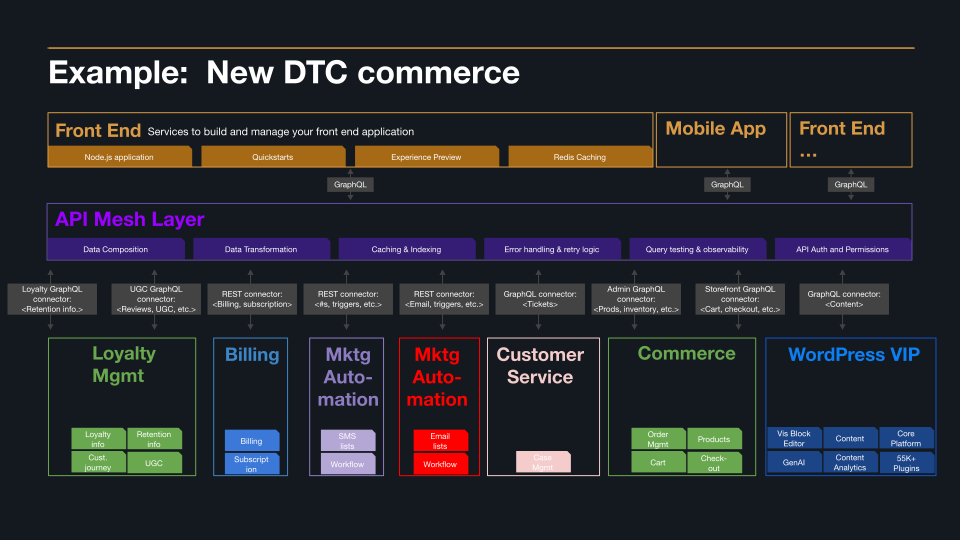
A relatively new direct-to-consumer (DTC) brand wanted to create an integrated commerce experience. Starting from scratch, they needed to select not just a CMS, but also a commerce provider, solutions for customer service, loyalty management, and billing, plus two marketing automation solutions, one for an email channel and another for SMS. 

Some used pre-built connectors, others GraphQL, and others REST. Using the API Mesh, they delivered a top-notch commerce experience while accelerating development and ensuring maintainability—even as they rapidly evolved and experimented with new solutions.

Schematic showing the VIP API Mesh between front end and other services, including billing, marketing automation, commerce, and the VIP platform.

Building atop of years of technology investments

Not all organizations have the luxury (or burden) of building from the ground up. 

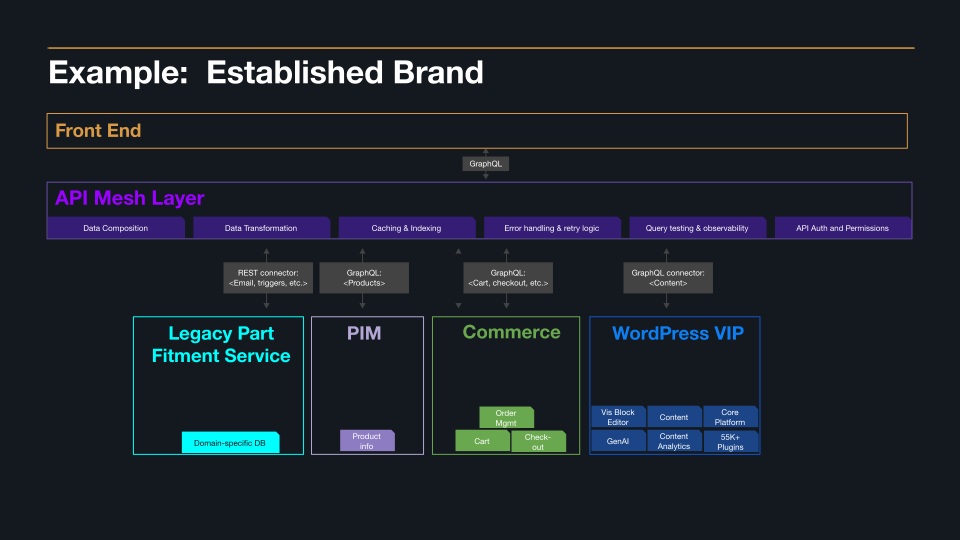
Established brands have years of investments and domain-specific applications to integrate. In the second example below, on top of the CMS and commerce platforms, a brand leveraged Product Information Management (PIM) outside their commerce system. They also had a part fitment application from another provider that fed in data about which components were needed in which cases. 

Challengingly, this application typically returned data quite slowly (often measured in seconds) and returned it in XML format. Even with these limitations, the API Mesh’s caching and data transformation capabilities made it possible to build a compelling, permanent experience. 

Schematic showing the VIP API Mesh building atop technology investments.

Aggregating media from multiple systems

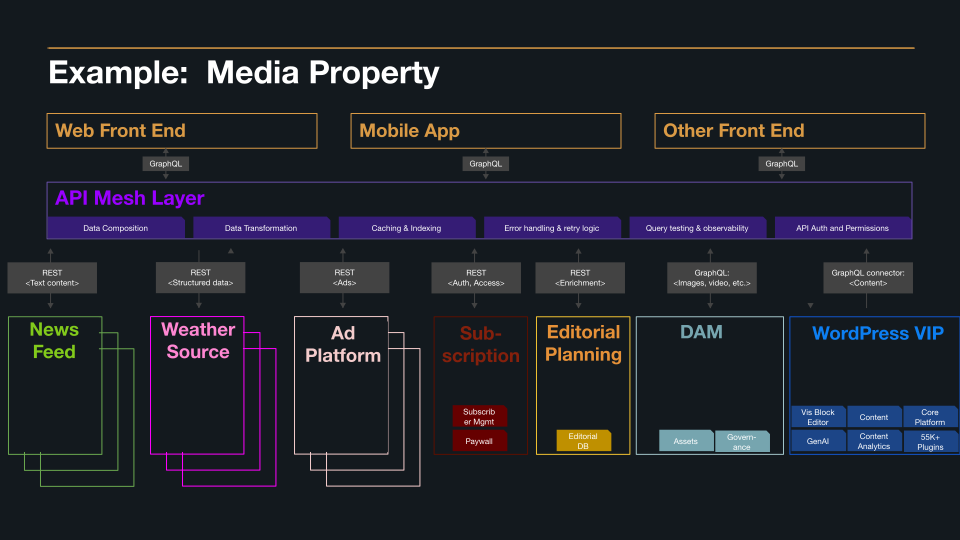
A media customer needed to build an application pulling data not just from their CMS, but also from a Digital Asset Management (DAM) system for imagery and rich media, a variety of external news, weather and advertising feeds, and systems for subscription management and editorial planning. 

Here, the media company delivered a compelling reader experience, even in the face of a complex and changing media landscape where not everything they needed to be successful was produced in their own newsroom.

Schematic showing the VIP API Mesh aggregating media from multiple systems.

The API Mesh: a great digital integrator

These possibilities are just the tip of the iceberg. Every organization is different, of course. But the true power of the VIP API Mesh lies in its ability to be tailored to your business’s unique needs and aspirations. 

In summary, the VIP API Mesh is a powerful tool that integrates multiple backend systems, enabling flexibility, innovation, and improved user experiences while reducing costs and overhead, providing:

  • Seamless integration of backend systems for a unified digital experience
  • Adaptability to evolve your digital ecosystem
  • Simplified management and maintenance of your digital infrastructure

Why settle for a digital experience that falls short of your vision?

Embrace the future with WordPress VIP’s API Mesh and unleash the true power of your digital presence. Contact us now to get started.

Author

Michael Khalili, Director of Product Marketing, WordPress VIP

CMS and Composability and AI, Oh My

CMS and Composability and AI, Oh My

Two experts weigh in on top 2024 CMS trends and why CMS remains the central nervous system of digital

It’s not every day you get to pick the left and right brains of a Forrester Research principal analyst who closely watches the content management system landscape, separating the “hope from the hype” when it comes to 2024 CMS trends. 

VIP CEO Nick Gernert did just that, sitting down with Chuck Gahun, a noted authority on digital experience technology and vendors that “deliver the next generation of content, digital media, and product information capabilities.”

During their recent session CMS: Separating What’s Real From the Hype, the pair explored CMS tech worth watching (hybrid systems, low-code tools, VR), how AI is going to give us back more hours in our days, and why no one should ever take away Chuck’s CMS.  

Let’s get to our favorite takeaways.

CMS: more important than ever

Despite being a mature technology, CMS continues to evolve to meet changing business needs and ‌evergreen trends like building captivating digital experiences for audiences. 

“CMS is still the hub for digital experiences,” said Gernert. “Every technology evolution creates more opportunity for folks to engage and‌ work on something that’s more fulfilling ultimately. It’s all about finding better ways to do our work.”

“The CMS is my backbone for my digital experience. I need my vendor—whomever the vendor is—to accelerate their roadmap. I need them to do more and more and more.”

— Chuck Gahun, Principal Analyst, Forrester Research 

Yes, the core capabilities of a CMS—content authoring, aggregation, access control, workflow, search orchestration, analytics, and data management—remain largely unchanged over the years.

But a new generation of emerging features like low-code tools, content hubs, live experience preview, and content planning tools are making waves, said Gahun.

And that means ‌more CMS choice than ever before for business leaders and development teams looking for a competitive edge.

“CMS is going to continue to deliver experiences, now in a new realm,” said Gahun. “Front-end framework leaders I connect with are really excited about the VR frontier.”

Different CMS architectures for different folks

Better yet, modern CMSes now offer the hybrid flexibility to support both traditional capabilities—such as server-side rendering and templating—as well as pure headless front-end capabilities, said Gahun.

“When I want to launch a jazzy marketing campaign for my new product, I want to [break] out of the mold and create something compelling.”

—Chuck Gahun

Organizations can prefer to maintain their corporate websites using a set of predefined templates, while also having the freedom to create compelling, modular front-end designs for one-off marketing campaigns or product launches.

“When I want to launch a jazzy marketing campaign for my new product, I do want a front-end framework based on my brand standards,” added Gahun. “Because I want to [break] out of the mold and create something compelling.”

That desire can be intoxicating, even voracious. 

“The CMS is my backbone for my digital experience,” said Gahun. “I need my vendor—whomever the vendor is—to accelerate their roadmap. I need them to do more and more and more. But please don’t take my CMS away in any way.” 

That said, the decades-long transition from traditional to headless and now to hybrid systems does present challenges in terms of content management and scalability.

Businesses need to consider their risk appetite, the business context, and the (potential) complexity of maintaining a so-called composable stack.

“In a traditional CMS, you had an all-in-one system: the authoring engine, the rendering engine, and the templates all connected,” said Gernert. 

Now, before implementing a hybrid CMS model, with the front and back ends of a CMS decoupled from one another, “a certain amount of corporate communication needs to happen,” added Gahun. 

AI + CMS = adding “value to our days”

Not surprisingly, Generative AI is increasingly being used in CMS platforms for tasks like content generation, translation, and personalization. 

Not only is AI helping businesses automate those routine needs and enhancing operational efficiency, but it’s also helping lead them toward the twin holy grails of content personalization and customer engagement. 

“[AI is] going to… give us time back time to do the things that we do want to do. ”

—Chuck Gahun

As elsewhere, though, businesses need to be mindful of the regulatory implications of blindly using AI in their CMS toolbox and workflows, especially regarding data privacy and intellectual property rights.

Despite that concern, “I continue to be optimistic about generative AI,” said Gahun. “It’s going to add a lot of value to our days—doing tasks we didn’t really want to do [in the first place]. It will give us time back time to do the things that we do want to do. Which will help us raise the bar for society.”

Watch the full CMS: Separating What’s Real From the Hype session here.